

Policy on Letters of Support
In general, ASTRO does not offer letters of support for research funded through the NIH. However, letters of collaboration may be granted for studies related to comparative effectiveness.
Research
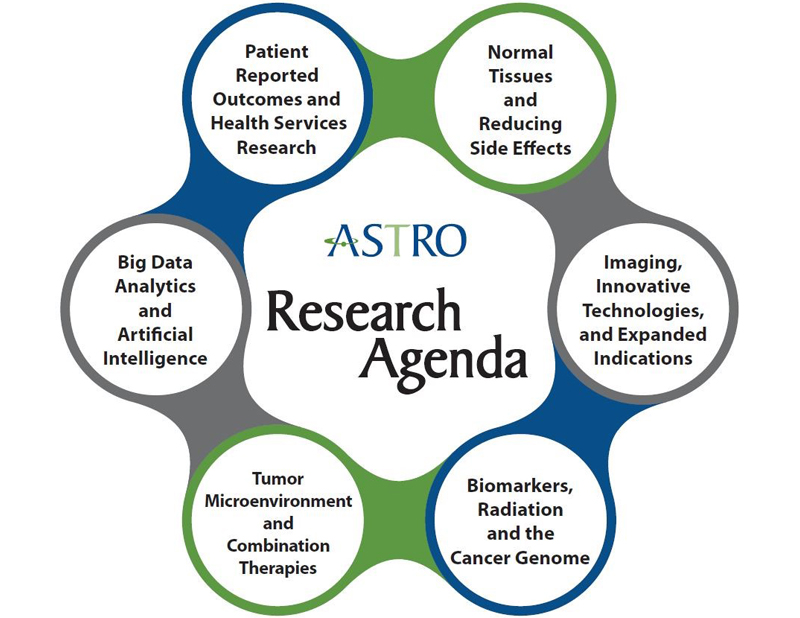
Collecting, processing, and curating patient level radiation oncology data will be a powerful tool in our path toward precision medicine and learning health systems. Artificial intelligence (AI) can help realize the promise of precision medicine and modernize healthcare in three major areas: (1) disease prevention, (2) personalized diagnosis, and (3) personalized treatment. AI tools driven by novel methods must remain a priority in radiation oncology research and for future integration into clinical workflows. In close collaboration with human intelligence, AI technologies can help usher in more effective and personalized healthcare worldwide.
Examples of research topics:
- How to effectively aggregate “big data” in the clinical environment to enable analysis and translate results to positively impact radiation oncology practice?
- How to personalize radiation oncology planning/treatment with AI applications? What are the important data streams to best help personalize treatment using AI methods?
- How to use AI to improve efficiency and standardization in clinical practice?
Precision medicine is redefining treatment options and regimens. Increasingly, patients receive treatments based on the genomic profile of their lesions. Understanding how changes in the genome influence radiation treatment effects in both tumors and normal tissues will have a significant impact on cancer therapy and outcome prediction. Learning how to best use genomic tools and finding new biomarkers in radiation therapy will lead to better patient outcomes, including the identification of patients who are most likely to benefit from local consolidative therapy for oligometastatic diseases. Developing less invasive “liquid biopsies” will be fundamental to not only cancer detection and treatment selection but also disease progression monitoring and second-line treatment option evaluation.
Examples of research topics:
- What panels of biomarkers, across radiation modalities, can be used to predict and assess radiosensitivity, radioresistance, enhanced radiation toxicities, the clinical benefit of combining irradiation with immune checkpoint inhibition, and the clinical benefit of oligometastatic disease directed radiotherapy?
- How to best validate and use liquid biopsies?
- What radiation-induced changes in gene/protein expression occur as a function of tumor type and site, and what are the effects of dose per fraction (i.e. conventional vs hypofractionation vs SABR/SBRT)?
Radiation treatment technology and indications need to continually evolve, improve and expand. Improving technology and treatment modalities that increase efficacy while decreasing the toxicity to normal tissues and finding new medical indications where radiation can improve upon existing non-radiation treatment approaches is a primary research focus. There is renewed research interest in the use of low-dose radiation for painful or degenerative non-malignant disorders.
Examples of research topics:
- How to use imaging biomarkers in treatment planning, delivery, and review?
- What new technologies or methods can increase efficacy and reduce toxicity (i.e. particles, FLASH, GRID and others?
- How to expand research on emerging radiopharmaceuticals in the context of advances in identifying tumor-selective markers, ligand generation, and radioisotope availability?
Therapeutic radiation dose is often limited by toxicity to normal tissues, which have a variable response to radiation based on tissue type (histology, parallel or serial organs), radiation type, total dose, dose rate, time after exposure, concurrent therapies and other factors. Focused studies into how radiation affects normal tissue will provide better understanding of how to reduce treatment toxicity.
Examples of research topics:
- How can we predict radiation-induced toxicities by studying dosimetric factors, normal tissue genetics, epigenetics & gene expression patterns, and other host factors including the tissue/tumor microenvironment and the immune system?
- How do normal tissues respond differently to radiation given at conventional versus high dose treatment and what is the underlying biological basis of the effects whereby normal tissues are selectively spared from radiation-induced toxicities?
- How can the tissue/tumor microenvironment including inflammatory responses, oxidative stress, and fibrosis be modulated to reduce toxicity?
Patient-centered healthcare and health services research are important in clinical trial design, evaluation of new radiation technology, and the delivery of value-based care. Patient reported outcomes enhance the sensitivity and accuracy of outcome measurement and improve patient engagement in both treatment and research. Health services research evaluates the context, conduct, and quality of healthcare delivery.
Examples of research topics:
- How to reduce disparities and improve access to radiation therapy for patients?
- How to determine the best treatment options for an individual patient or disease type by employing comparative effectiveness research?
- How to identify and manage financial toxicity and deliver the most cost-effective care?
Radiation has a complex effect on the tumor microenvironment that is also impacted by concurrent therapies. There is much to learn about what combinations (radiation, surgery, chemotherapy, small molecules, and biological agents including immunotherapy) are most effective for any given tumor. As cancer therapy evolves, it is critical to have the most current knowledge of how to best implement radiotherapy with surgery and systemic agents to provide a safer and longer-lasting solution to eliminate cancer growth and metastases.
Examples of research topics:
- How does radiation modulate the immune system, and how does this differ by histology, stage, combinatorial therapies, and patient factors?
- What is the most effective combination therapy for specific cancer types and stages?
- How are the tumor microenvironment and the effectiveness/risks of combination therapies impacted by variations in fractionation schedule, dose per fraction, dose rate, and radiation modality (i.e., photons, particles)?
Funding Opportunities
ASTRO supports early career scientists by offering training fellowships, seed grants and career development awards.